
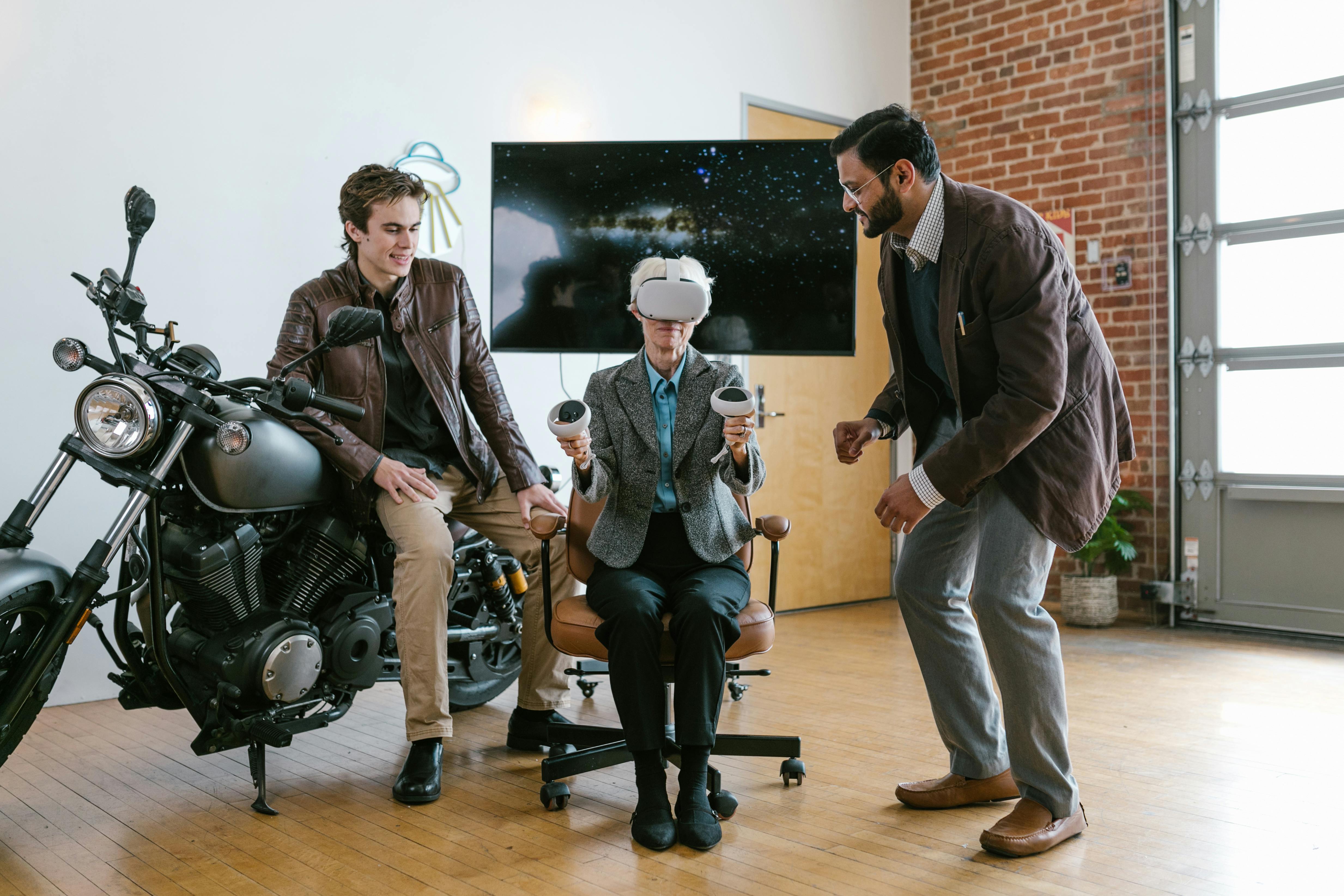
Leveraging Emerging Technologies for Hyper-Inclusive Experiences
The headline technologies of the decade—AI and AR—are often discussed in terms of speed, visual fidelity, and personalization. But their most profound impact on marketing will be how they dismantle barriers to entry for diverse audiences.
AI: Automating Empathy at Scale
Artificial Intelligence is moving past basic content drafting to become an essential accessibility co-pilot. Marketers often struggle with the resources needed to create high-quality audio and video content, a bottleneck accessibility exacerbates without dedicated production teams. AI solves this by automating complex asset creation:
- Automated Audio Descriptions: For visual narratives, AI models are becoming sophisticated enough to generate high-quality, context-aware audio descriptions that capture the nuance of complex graphics or video action, saving hundreds of production hours.
- Dynamic Language Simplification: AI can analyze marketing copy—especially for technical products or complex financial services—and instantly generate simplified, plain-language versions for users with cognitive disabilities or those using language learning tools. This is hyper-personalization for cognitive load.. Find out more about Digital accessibility as a marketing growth strategy.
- Real-Time Captioning & Translation: AI-powered voice and conversational tools now offer near-perfect, real-time translation and captioning across live events and video content, instantly expanding reach across linguistic and hearing-impaired barriers.
The trend toward an AI-First Approach in marketing means these tools are becoming standard. By feeding these systems accessibility requirements upfront, we ensure that efficiency gains are inherently inclusive.
AR: Designing Immersive Worlds with Cognitive Pathways
Augmented Reality (AR) experiences—from virtual try-ons to interactive product tours—are a major growth area, projected to contribute significantly to the global market. However, a poorly designed AR experience is inherently exclusionary if it relies solely on perfect motor skills or unassisted vision. The goal is to design AR with **equivalent cognitive and physical pathways**. Consider an AR visualization of a new car interior:
- Gesture Dependency: If the primary way to explore the dashboard features is via specific, precise hand gestures, users relying on screen readers, voice control, or alternative input devices are locked out.
- The Inclusive Fix: The experience must offer *equivalent* pathways. Overlay menus should be navigable via keyboard tabbing or simple voice commands (“Show me the infotainment system”)—not just intricate hand swipes.. Find out more about Digital accessibility as a marketing growth strategy guide.
When brands intentionally design these bleeding-edge AR campaigns with accessibility upfront, they ensure their most innovative assets are also their most broadly reachable. Remember, 72% of brands already agree that AR can help ensure products or events are accessible to all. This is not a compromise; it’s a guarantee that the 200% higher engagement AR offers reaches the widest possible audience.
Moving Beyond Metric Scores to Genuine User Confidence
We have established that WCAG compliance is the price of entry in 2025. But what separates the market leaders from the compliant laggards? It’s the qualitative difference between *passing a test* and *earning trust*. The ultimate goal is to foster a state where digital accessibility is measured by the *tangible, qualitative confidence* users have when interacting with a brand’s digital environment. Think about it: when you visit a major bank’s app or an established retailer’s website, you don’t consciously think, “I hope this passes WCAG 2.2 AA.” You just *expect* it to work—to be logical, to load fast, and to respect your time, regardless of how you access it. That instinctive, subconscious level of brand assurance is the true marker of success.
The Trust Gap: Why Scores Fail to Capture Human Experience
Automated testing tools are fantastic for catching the low-hanging fruit—the missing alt-text or the insufficient color contrast. But they cannot flag a complex, multi-step checkout process that becomes confusing due to information overload (a cognitive barrier) or a poorly structured AR overlay that frustrates a power user. This frustration erodes trust far faster than a missed automated check. A user who feels respected and capable on your platform will return, spend more, and recommend your brand. A user who feels their time has been wasted or that the experience was built without them in mind will leave—and tell others about it. This shift involves building **Digital Marketing Strategy** around user journeys, not just guidelines. We must ask:
- Does the user feel understood?. Find out more about Digital accessibility as a marketing growth strategy tips.
- Can a user with a screen reader complete this purchase as quickly as a mouse user?
- Is the cognitive load on this landing page manageable for someone scanning quickly?
This is where the human element—empathy, the very thing AI struggles to replicate—must guide the overall strategy. Understanding this difference is key to mastering Digital Experience Research.
The Competitive Moat: Accessibility as an Offensive Growth Strategy
For too long, accessibility was framed as a defensive necessity—a legal risk to mitigate. In the competitive climate of 2025, this perspective is actively costing businesses market share. Viewing inclusive design as an *offensive* growth strategy is what builds an enduring competitive advantage.
Expanding the Market and Deepening Loyalty. Find out more about Digital accessibility as a marketing growth strategy strategies.
When your innovative campaigns—powered by AI-generated video or AR product demos—are universally usable, you are not just including people with disabilities; you are optimizing for every user:
- Elderly Users: Many older users benefit significantly from high contrast, clear labeling, and simplified navigation, all core tenets of accessibility.
- Situational Disabilities: A user holding a baby, walking in bright sunlight, or having slow internet is dealing with a *situational* impairment. Inclusive design ensures your content is robust enough to handle those moments, leading to better **Conversion Rate Optimization**.
- Universal Usability: Designing for the extremes—the most restrictive device, the slowest connection, the highest cognitive load—results in a superior experience for everyone.
Brands that integrate high-level accessibility into their core *design systems* create a durable moat. Rivals focused only on surface-level compliance will struggle to replicate the deep, seamless user confidence you foster. For example, retailers leveraging AR for product visualization are seeing up to a 94% increase in conversion rates from these immersive experiences. Imagine that conversion lift, multiplied by including the 1 billion+ people worldwide with disabilities. That is not just good ethics; that is high-level business foresight.
Actionable Takeaways: From Vision to Execution in Late 2025. Find out more about Digital accessibility as a marketing growth strategy insights.
The future horizon is here, and it demands integration. Here are three concrete steps your team can take to pivot accessibility from a compliance hurdle to a genuine driver of marketing innovation right now:
1. Audit Beyond the Automated Scan
Stop relying solely on automated tools. While they catch the easy errors, they miss the crucial contextual failures.
- Action: Commission manual audits focused on **user journeys** (e.g., the entire path from ad click to purchase confirmation) using assistive technologies like screen readers (JAWS, NVDA) and keyboard-only navigation.
- Action: Incorporate cognitive accessibility checks into your QA process, ensuring instructions are clear and steps are logically grouped, especially within new UX/UI Design.
2. Mandate Inclusivity in Tech Procurement
When evaluating new AI or AR platforms, the accessibility feature set must be a non-negotiable requirement, not a “nice-to-have.”
- Action: For AI vendors, require proof of capability in generating compliant audio descriptions or dynamic text simplification. Ask for case studies specifically on accessibility asset creation.
- Action: For AR development, demand prototypes that can be fully controlled via voice command and keyboard input *before* the final design phase begins. Make sure your Vendor Management process reflects this.
3. Reframe Your Metrics for Trust. Find out more about Designing AR product visualization with inclusive pathways insights information.
Your success reports need a new column. Move beyond technical scores to measure *impact*.
- Action: Track qualitative feedback via user testing groups that include participants with diverse abilities. Tag qualitative data (e.g., “Felt frustration,” “Easy to navigate”) and correlate it with conversion/retention data.
- Action: Start reporting on **Time-on-Task** parity. If a task takes a user with a screen reader three times longer than a mouse user, you have identified an innovation opportunity, even if you technically passed WCAG.
Conclusion: The Inescapable Link Between Innovation and Inclusion
As the digital world continues its breakneck sprint into AI-driven personalization and immersive AR environments, the foundational reality remains: technology only matters if people can use it. In 2025, digital accessibility is no longer a niche concern for compliance officers; it is the primary catalyst for marketing innovation. It is the strategic intelligence that ensures your most advanced technology resonates with the broadest possible audience. By intentionally weaving inclusion into the fabric of your AI workflows and AR designs, you stop chasing trends and start setting them, building a brand reputation synonymous with excellence, foresight, and genuine connection. The moat around your business won’t be built by proprietary code alone, but by the undeniable assurance that your digital world works, logically and respectfully, for absolutely everyone.